
THE RAGDOLLS
Ragdolls, also called doll cats, are cute, semi-long-haired kittens. They are similar in some respects to the sacred Burmese, but are much larger in size and also differ in the shape of their head, nose and large, powerful paws. What is fascinating about this breed, however, is undoubtedly their character, which is incredibly docile, peaceful and affectionate, but also curious and in need of affection. Ragdolls are one of the most suitable breeds for keeping in a flat... but woe betide you if you leave them alone! Just like a small dog, they will suffer from your absence... so if you are not at home all the time, it is best to keep them in pairs or with other pets with whom they socialise without any problems. The story of how this breed was born is also very mysterious and fascinating, read more in the section "The Ragdoll".
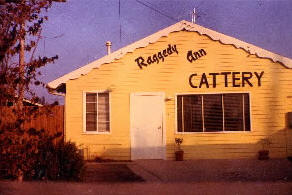
The Ragdoll is a North American breed with blue eyes and a distinctive colourpoint coat. It is a large, muscular cat with a semi-long, soft and silky coat. Developed since the 1960s by the American breeder Ann Baker, it is known for its docile and calm temperament and affectionate nature. The name Ragdoll (rag doll) derives precisely from the behaviour of this cat, which is very relaxed when held in its arms.
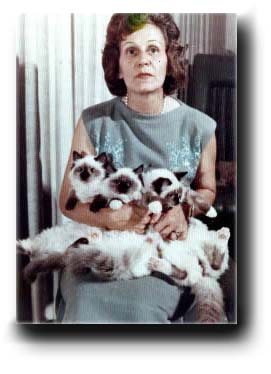
THE MYSTERIOUS HISTORY OF RAGDOLLS
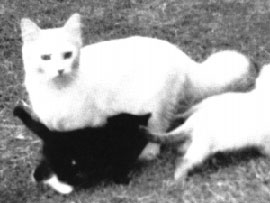
In the 1960s, a common white long-haired cat named Josephine, who had already had a few litters of normal characters, had an accident and was taken by her owner, Ann Baker, to the University of California Veterinary Hospital. There Josephine underwent surgery. After the operation, Ann Baker became convinced that the cat had been subjected to a secret government experiment, which made Josephine docile, relaxed when held and immune to pain. Confirming the thesis was the following litter, which showed the same character traits.
Thus the first Ragdoll breeding was born!
 |
 |
BREED STANDARDS
VARIETIES
There are 3 varieties of Ragdoll:
COLOURPOINT: The extremities (muzzle, ears, legs, tail) are intensely coloured. The body is lighter in colour than the tips. There must be no white spots.
MITTED (GLOVED): The extremities are coloured, the body is lighter. White chin. White and symmetrical front gloves, but must not be higher than wrist. Hind legs white up to the hock . A white stripe starts from the chin and goes to the base of the tail covering the belly. There may be a white blaze on the nose or between the eyes.
Defects: lack of white chin, dark spots on the gloves or belly.
BICOLOR: Paws, feet, belly and collar must be white. An inverted white "V" covers the mask on the muzzle. Dark ears and tail. The body is paler than the tips. Pink nose and plantar pads. It is to be noted that the bicolour variety is subdivided in turn in 4 sub-categories distinguishable only by the genetic code or the percentage of white and that is the bicolour High-Mitted, the True bicolour, the bicolour Mid-High-White and the bicolour High-White. Defects: white spots on ears and tail. Dark spots on legs, belly, V and parts that must be white.
COLOURS
These above-mentioned varieties exist in four original colours:
- SEAL dark brown tip colour
- BLUE colour of the tips blue grey
- CHOCOLATE colour of the tips light chocolate
- LILAC colour of the tips pinkish
New colours and varieties have now been admitted by the TICA with their results:
RED (FLAME): red tip colour
TORTIE: turtle scale tip colour.
TABBY (LINX): is a new variety that is associated with all colours. Characteristic of the Tabby Point cats is to combine a tiger pattern with the colour and variety of the cat. Therefore the Tabby Point exists in the 3 varieties: Colourpoint, Mitted and Bicolour, in the 4 traditional colours: seal, blue, chocolate and liac; and in the new colours: red, tortie.
BODY STRUCTURE
Structurally, the Ragdoll is a long, muscular cat with the hind legs higher than the front ones. Broad chest. The tail is thick at the base and of proportionate length to the body. The head has a flat plane between the ears. Well developed cheeks and chin. Nose without stop, with a slight curve in the hind third. Ears slightly bent forward. rounded at the tip. Large, oval eyes as blue as possible. Rounded feet with tufts of hair between the toes. Coat of medium length, longer around the face and on the neck. The coat is thick. soft and silky and lifts when the cat walks. Defects: narrow head, stop at the nose, Roman nose. Eyes of a different colour than blue. Fair chest, thin or long neck. Lack of tufts of hair between the fingers. Short tail. Defects common to all breeds: squinting, tail knot, hernias. (text taken from ragdolls.it)